My Contribution: ADOR™ Poster Presentation
Poster Title:Augmentation-Driven Organizational Redesign (ADOR™)
Introduction
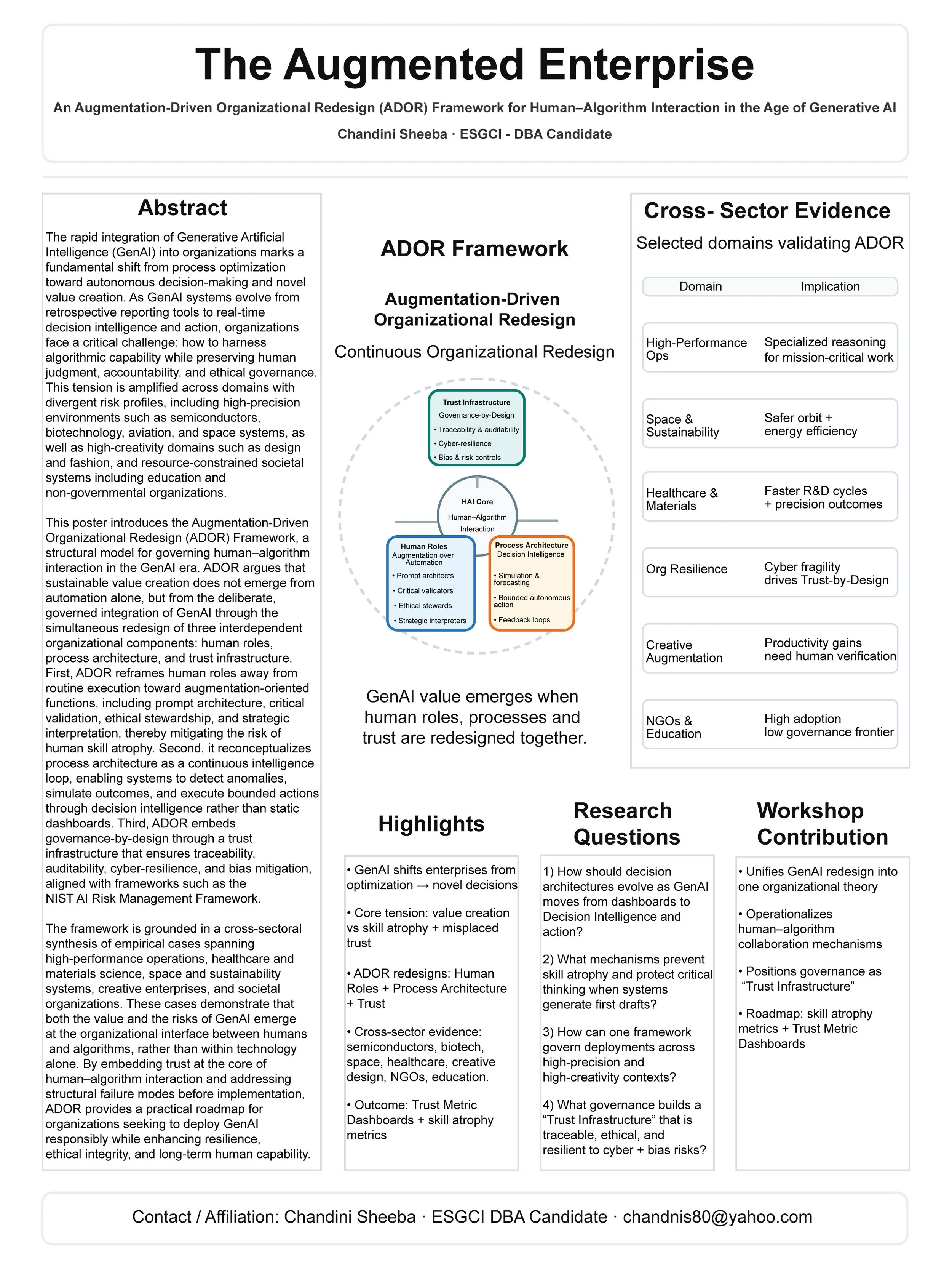
As part of the AI for Business Conference, I presented the Augmentation-Driven Organizational Redesign (ADOR™) Framework, a governance-oriented approach to helping organizations manage human–algorithm collaboration responsibly.
ADOR™ addresses a central organizational challenge: companies are introducing increasingly capable AI systems, but their leadership structures, employee roles, operational processes and accountability mechanisms are not always evolving at the same pace.
The framework proposes that responsible AI adoption requires more than selecting the right technology. Organizations must deliberately redesign how people work with AI, how AI-supported decisions move through operational processes and how accountability is maintained as systems become increasingly autonomous.
8 Key Ideas Presented Through ADOR™
1. Augmentation Should Come Before Automation
ADOR™ begins with the principle that AI should expand human capability rather than automatically replace human participation.
Organizations should first determine how technology can improve analysis, creativity and decision-making before deciding whether a task should be fully automated. This protects human agency while helping organizations capture the value of AI.
2. Human Judgment Must Remain Visible
When AI contributes to a decision, the role of human judgment should remain identifiable. Organizations need to know who reviewed the output, who approved the action and who remains responsible for the result.
Human oversight should be designed into the operating model rather than added only after a problem occurs.
3. Human Roles Must Be Deliberately Redesigned
AI adoption changes what employees do and how their work creates value. Routine execution may decrease while interpretation, critical thinking, validation and oversight become increasingly important.
ADOR™ encourages organizations to prepare employees for roles such as strategic interpreters, AI supervisors, prompt architects and ethical validators.
4. Processes Must Support Continuous Intelligence
Traditional processes often depend on static reports and retrospective analysis. AI-enabled processes can identify anomalies, simulate outcomes and provide continuous decision support.
Organizations must redesign workflows so that AI-generated insights are evaluated, escalated and acted upon responsibly rather than accepted without review.
5. Trust Infrastructure Must Be Built into the System
Responsible AI requires traceability, transparency and clearly defined accountability. These controls should be embedded within systems and workflows rather than treated as separate compliance exercises.
Trust infrastructure helps organizations understand how an output was produced, who relied upon it and how a decision can be reviewed or corrected.
6. Governance Must Be Connected to Operations
Policies alone cannot govern AI. Governance must be translated into operational responsibilities, approval authority, monitoring processes and intervention procedures.
ADOR™ connects leadership expectations with the structures employees need to make responsible decisions during everyday AI use.
7. Accountability Must Remain Human
Even when an AI system performs an action autonomously, responsibility cannot be transferred entirely to the technology.
Organizations must identify the leaders and decision-makers accountable for approving, monitoring and correcting AI-enabled systems. Automation should never create ownerless decisions.
8. Responsible Structure Enables Sustainable Innovation
Governance should not be viewed only as a restriction. Appropriate structure gives organizations the confidence to experiment and scale while maintaining control over ethical, operational and reputational risk.
ADOR™ positions governance as an enabling architecture for responsible innovation.
3 Practical Examples in Action
Example 1: Cross-Functional Generative AI Adoption
An organization introducing generative AI across finance, human resources, operations and customer service could use ADOR™ to define how each department may use the technology.
The organization would establish appropriate human review points, decision ownership, escalation procedures and shared governance expectations. This would help prevent fragmented adoption and inconsistent accountability across departments.
Example 2: AI-Assisted Workforce Decisions
An organization using AI to support hiring, performance or workforce-planning decisions must ensure that employees remain accountable for consequential outcomes.
ADOR™ could help the organization distinguish between AI-supported analysis and decisions requiring human judgment. It could also support clearer review processes, documentation requirements and intervention authority when an output appears biased, incomplete or inconsistent with organizational values.
Example 3: AI-Enabled Cybersecurity Operations
An organization using AI to detect threats and recommend containment actions must balance response speed with operational safety.
ADOR™ could help define which actions may be automated, which require human authorization and who possesses override authority. This creates a structured relationship between machine speed, human judgment and executive accountability.
Photograph
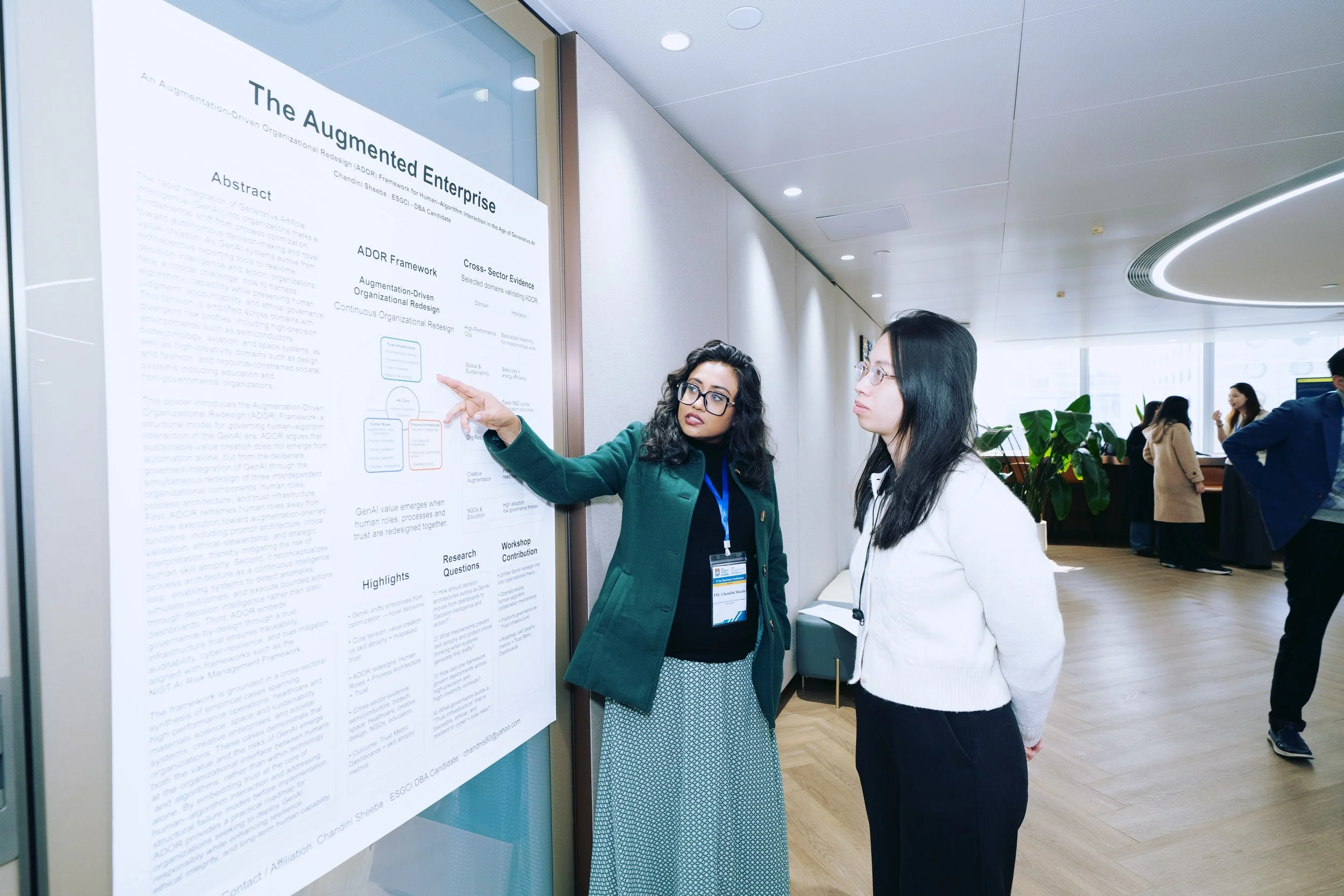
Chandini Sheeba presenting the Augmentation-Driven Organizational Redesign (ADOR™) Framework at the AI for Business Conference in Hong Kong, January 2026.
Questions and Feedback
The presentation generated interest in how organizations can preserve human accountability while increasing their use of autonomous and generative AI systems. Discussion focused on the practical challenge of translating responsible-AI principles into organizational roles, workflows and governance responsibilities.
Feedback from faculty, students and practitioners reinforced the relevance of leadership-led governance and structured human–algorithm collaboration. It also highlighted the need for frameworks that help organizations move beyond general ethical commitments and establish practical operating structures for responsible adoption.
Conclusion
Presenting ADOR™ provided an opportunity to connect organizational theory with the practical governance challenges created by artificial intelligence.
The central message of the framework is that responsible AI adoption requires organizational redesign. Human roles, operational processes and trust infrastructure must evolve together if organizations are to preserve accountability while benefiting from technological innovation.
This public overview presents the purpose and major components of ADOR™ while protecting its detailed assessment methods, internal decision architecture and other proprietary elements.
People first. Systems strong. AI smart.