
Frameworks for Ethical AI & Governance
Introduction
As artificial intelligence becomes embedded in organizational decision-making, ethical leadership can no longer remain an abstract principle. Leadership values must be translated into systems, processes and governance structures that guide how AI is designed, deployed and supervised.
The central challenge is not a lack of technology. Organizations have access to increasingly capable tools, but many lack the structured frameworks required to connect human intention with responsible technological execution. Without clear decision rights, accountability mechanisms and oversight, AI adoption can become fragmented, difficult to govern and misaligned with organizational values.
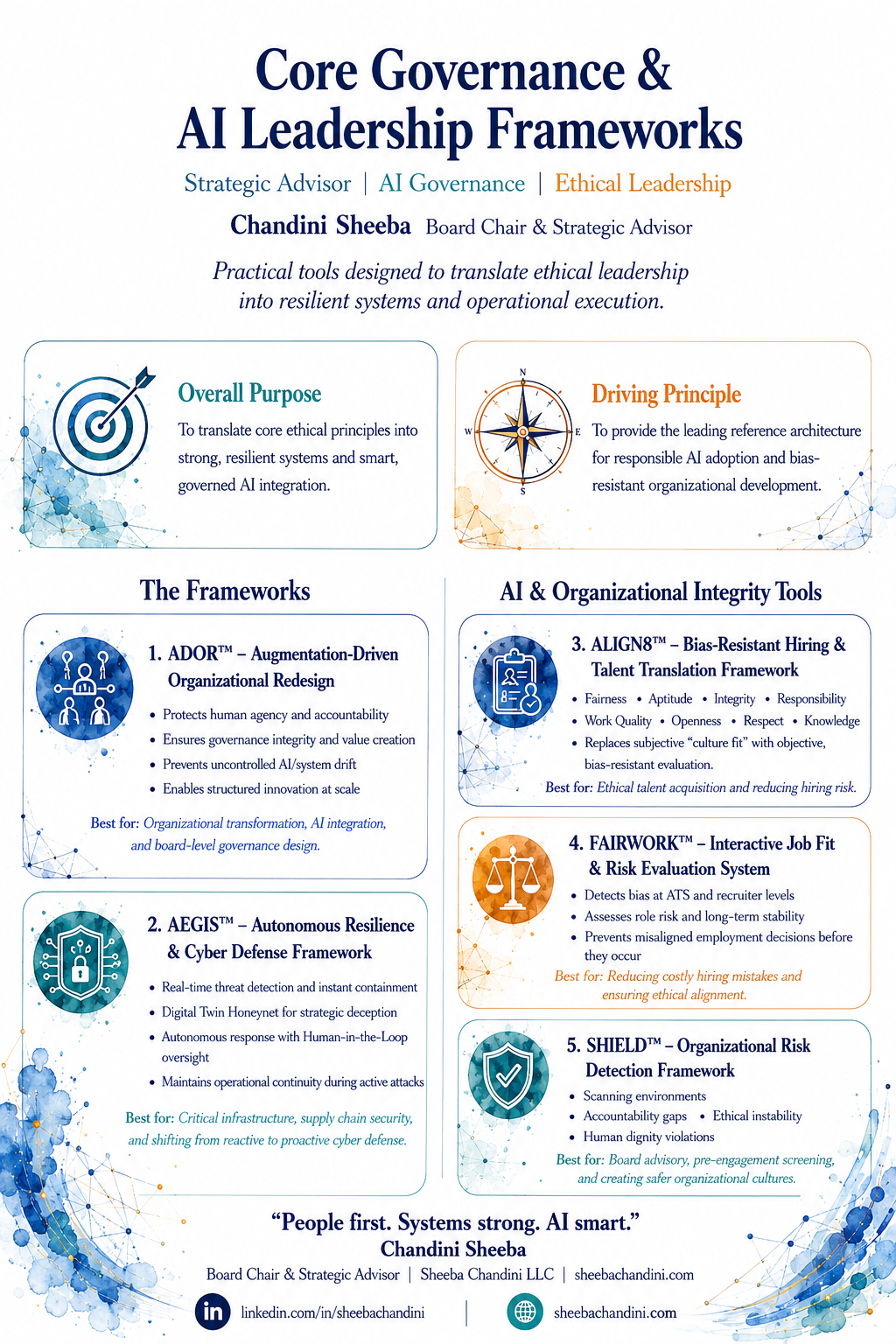
Governance-led design provides the structure needed to turn responsible leadership into operational practice. My frameworks—including ADOR™, ALIGN8™, FAIRWORK™, AEGIS™ and SHIELD™—address different dimensions of organizational transformation, talent decision-making, cybersecurity resilience and institutional accountability. Together, they reflect a shared philosophy:
People first. Systems strong. AI smart.
8 Key Principles Behind the Frameworks
1. People First, Always
AI should strengthen human capability without removing human dignity, judgment or agency. Technology must support people rather than displace accountability for decisions that affect employees, customers and communities.
Every framework begins with a human-centered question: How can this system improve organizational capability while protecting the rights, responsibilities and decision-making authority of the people involved?
2. Governance Before Scale
Scaling AI without appropriate governance can magnify errors, bias and operational risk. Organizations need clearly defined policies, responsibilities, escalation pathways and oversight mechanisms before AI-enabled processes are expanded across departments.
Governance does not begin after deployment. It must be designed into the system from the beginning.
3. Accountability Is Non-Negotiable
Automated decisions must never become ownerless decisions. Organizations should establish who approves an AI system, who monitors its performance, who can intervene and who remains responsible when outcomes create harm or unintended consequences.
Clear accountability makes decisions traceable, reviewable and correctable.
4. Bias Is a System Risk, Not Only a Data Problem
Bias can originate in training data, but it can also emerge from organizational assumptions, job requirements, evaluation criteria, workflows and decision pathways. Addressing bias therefore requires more than technical model testing.
Responsible organizations examine the entire decision system—including the people, policies and processes surrounding the technology.
5. Structure Enables Innovation
Governance is often portrayed as a barrier to innovation. In practice, well-designed governance gives organizations the confidence to experiment, learn and scale responsibly.
Clear boundaries, review points and decision rights make it possible to pursue innovation without exposing the organization to uncontrolled legal, ethical, operational or reputational risk.
6. Human-in-the-Loop Oversight Is a Strategic Advantage
Human oversight should not be treated as a temporary safeguard that disappears as AI becomes more capable. It is an essential component of responsible organizational design.
People remain necessary to interpret context, challenge questionable outputs, manage exceptions and make consequential decisions that require ethical judgment. The objective is responsible augmentation—not uncontrolled autonomy.
7. Alignment Must Replace Assumptions
Whether an organization is hiring employees, introducing AI or redesigning operations, decisions should be aligned with its mission, values, risk tolerance and long-term objectives.
Structured alignment reduces dependence on subjective impressions and helps ensure that people, technology and organizational strategy move in the same direction.
8. Prevention Is More Valuable Than Correction
The strongest governance systems identify vulnerabilities before they become crises. Preventive design includes early-warning indicators, accountability reviews, continuous monitoring, escalation protocols and clearly defined intervention points.
This principle applies across cybersecurity, AI governance, workforce decisions and organizational risk. Preventing avoidable harm is more effective than attempting to repair it after escalation.
3 Practical Examples in Action
Example 1: Organizational Transformation with ADOR™
Consider an organization introducing artificial intelligence across multiple departments. Without a shared structure, individual teams may adopt different tools, apply inconsistent controls and make decisions without clearly assigned ownership.
The ADOR™ Framework—Augmentation-Driven Organizational Redesign—provides an approach for examining how AI adoption affects human roles, organizational processes and governance responsibilities. It helps leaders define where AI should augment employees, where human judgment must remain decisive and how accountability should be maintained throughout the AI lifecycle.
Applied in this context, ADOR™ can support coordinated adoption, clearer decision rights, appropriate human oversight and stronger alignment between innovation and organizational values.
Example 2: Ethical Hiring and Talent Alignment with ALIGN8™ and FAIRWORK™
An organization experiencing inconsistent hiring outcomes may rely heavily on subjective concepts such as “culture fit.” These judgments can introduce bias, obscure job requirements and create misalignment between candidates and organizational needs.
ALIGN8™ provides a structured approach to evaluating talent across relevant dimensions such as fairness, aptitude, integrity, responsibility, work quality, openness, respect and knowledge. FAIRWORK™ complements this process by examining job fit, role-related risk and the potential consequences of misaligned employment decisions.
Together, these frameworks can help organizations create more consistent, transparent and evidence-informed hiring processes while reducing reliance on unstructured subjective judgment.
Example 3: Cyber Resilience and Risk Prevention with AEGIS™ and SHIELD™
In critical infrastructure and interconnected supply-chain environments, a cyberattack affecting one system can quickly disrupt multiple organizations. Traditional security approaches may detect threats but still lack the governance mechanisms needed to contain them while preserving essential operations.
AEGIS™ provides a resilience-oriented approach combining identity trust, continuous verification, autonomous threat detection, controlled containment and human-in-the-loop oversight. SHIELD™ complements this technical architecture by examining organizational risk indicators, accountability gaps, ethical instability and potential threats to human dignity.
Together, these frameworks can support a transition from reactive incident response toward continuous resilience, structured oversight and earlier intervention.
Conclusion: From Ethical Vision to Operational Practice
Ethical leadership is not demonstrated only through statements, policies or organizational values. It is demonstrated through the systems leaders create and the decisions those systems enable.
The future of artificial intelligence will not be defined solely by how advanced its capabilities become. It will also be shaped by whether organizations establish meaningful accountability, protect human agency and align innovation with institutional responsibility.
Organizations that lead responsibly will be those that translate principles into practice—building systems that are resilient, transparent, scalable and fundamentally human-centered.
People first. Systems strong. AI smart.