
8 Questions Boards Should Ask Before Scaling AI
Introduction
Artificial intelligence is moving rapidly from isolated pilots into systems that influence hiring, customer service, cybersecurity, financial decisions and enterprise operations. As deployment expands, AI risk becomes more than a technical concern. It becomes a matter of organizational governance, strategic alignment and board oversight.
Boards do not need to manage individual AI systems. They do, however, need sufficient visibility to determine whether management has established appropriate accountability, human oversight, evaluation and risk controls.
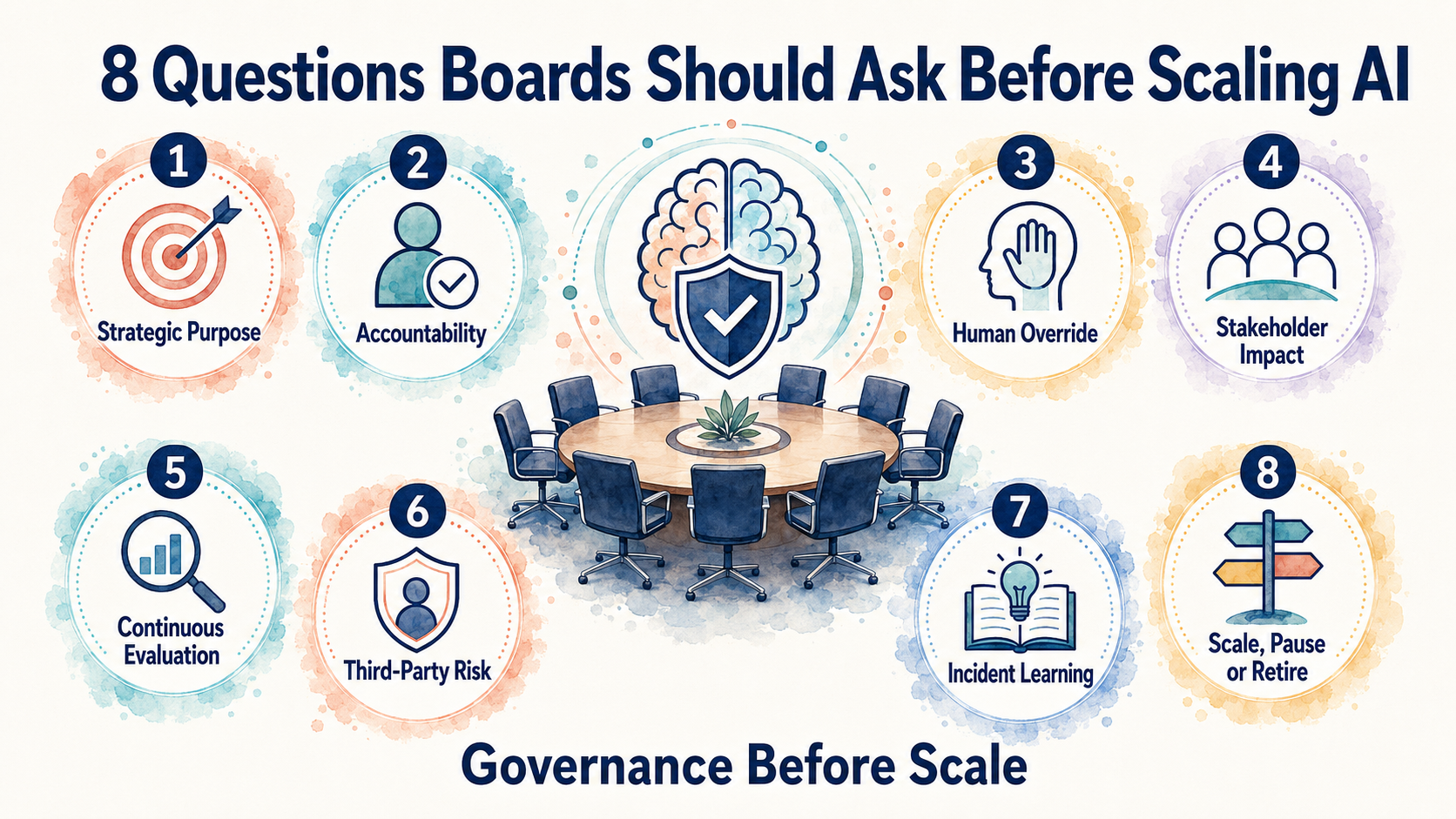
Before approving broader AI deployment, directors should ask eight essential questions.
1. What Business Problem Is the AI System Expected to Solve?
AI initiatives should begin with a clearly defined organizational problem rather than enthusiasm for a particular technology.
Boards should understand the intended value, affected stakeholders and evidence that AI is an appropriate solution. A successful technical pilot does not automatically demonstrate strategic value.
Board action: Require management to define the business objective, expected benefits, affected stakeholders, success measures and conditions under which the initiative should be reconsidered.
2. Who Remains Accountable for AI-Assisted Decisions?
An automated decision must never become an ownerless decision. Every AI system should have an accountable executive, clearly assigned operational owners and defined responsibility for its outcomes.
Accountability should extend across the system’s lifecycle—from approval and implementation to monitoring, incident response and retirement.
Board action: Request a clear accountability structure showing who approves the system, who monitors it, who responds when it fails and who reports material concerns to the board.
3. Where Can Humans Challenge or Override an AI Output?
Human oversight is meaningful only when people have the authority, information and time required to intervene.
Organizations should identify which decisions require human review, when an output may be challenged and who possesses override authority. Employees should also be protected from pressure to accept an AI recommendation simply because the system appears authoritative.
Board action: Confirm that consequential decisions include documented human review, escalation pathways and accessible override mechanisms.
4. How Are Cultural, Workforce and Stakeholder Effects Evaluated?
AI systems can affect job design, employee autonomy, customer trust, accessibility and cultural representation. These effects may not appear in traditional technical-performance measures.
Boards should understand how the organization evaluates impacts on employees, customers, communities and other stakeholders—particularly when AI influences employment, eligibility, access or public-facing communication.
Board action: Require impact assessments that examine workforce displacement, role redesign, cultural bias, accessibility, dignity and stakeholder trust.
5. How Are Reliability, Fairness, Security and Performance Continuously Evaluated?
AI evaluation cannot end when a system is approved. Models, data, operating environments and user behavior can change over time.
Organizations need ongoing monitoring for declining accuracy, unexpected behavior, bias, security vulnerabilities and performance drift. Evaluation should include both technical measures and organizational consequences.
Board action: Ask management to define monitoring indicators, testing frequency, reporting thresholds and the circumstances that require corrective action.
6. What Third-Party Dependencies Could Create Concentration or Systemic Risk?
Many organizations depend on the same models, cloud providers, datasets and AI platforms. A vulnerability or service failure affecting one provider can therefore disrupt numerous organizations simultaneously.
Boards should understand where critical dependencies exist, whether alternative providers or manual processes are available and how the organization would operate during a prolonged outage.
Board action: Request visibility into critical vendors, shared infrastructure, data dependencies, contractual responsibilities and operational-continuity plans.
7. What Happens When the AI System Causes or Contributes to an Incident?
Organizations need procedures for identifying, containing, investigating and reporting AI-related incidents. These procedures should cover incorrect decisions, harmful outputs, data exposure, security failures and unexpected operational consequences.
An incident-response process should also preserve evidence and support organizational learning rather than focusing only on restoring the system.
Board action: Confirm that AI incidents are integrated into enterprise incident management, with escalation criteria, response ownership, communication responsibilities and post-incident review.
8. What Evidence Is Required to Scale, Pause, Redesign or Retire the System?
Scaling should be a deliberate governance decision supported by evidence. Organizations should define the conditions that justify expansion and the thresholds that require intervention.
A system should not continue operating solely because the organization has already invested significant time or money in it.
Board action: Require predetermined criteria for scaling, pausing, redesigning and retiring AI systems, including clear authority to make each decision.
3 Practical Examples in Action
Example 1: AI-Assisted Hiring
An organization introduces AI to screen job applications and recommend candidates. Before approving wider deployment, the board should ask who remains accountable for hiring decisions, how the system is tested for bias and whether candidates can request human review.
Management should demonstrate that hiring professionals retain decision authority, evaluation criteria are documented and potentially discriminatory outcomes are monitored. The organization should also establish a process for challenging or overriding an inappropriate recommendation.
Example 2: A Culturally Adaptive Customer-Service Agent
A company introduces an AI agent that adjusts its language and communication style for users from different cultural communities.
The board should ask how cultural representation is evaluated, whether diverse stakeholders participated in testing and how sensitive conversations are transferred to human employees. Management should monitor for stereotyping, exclusion and declining customer trust—not only response speed and cost reduction.
Example 3: Autonomous Cybersecurity Response
An organization uses AI to identify suspicious behavior and automatically contain potential threats. Although rapid containment can reduce exposure, an incorrect action could interrupt critical operations.
The board should understand which actions may be performed autonomously, which require human authorization and who can override the system. Management should also demonstrate how third-party dependencies, operational continuity, incident escalation and post-incident learning are addressed.
Conclusion: Governance Before Scale
The central question for boards is not simply whether an AI system works. It is whether the organization can govern the system responsibly as its influence, autonomy and operational reach increase.
Responsible scale requires strategic purpose, clearly assigned accountability, meaningful human oversight, continuous evaluation and the ability to intervene when conditions change. It also requires leaders to recognize that AI failures can emerge from organizational structures and governance gaps—not only from technical defects.
Boards that ask these questions before scaling can help their organizations move from experimental adoption toward responsible, resilient and strategically aligned AI deployment.
People first. Systems strong. AI smart.