
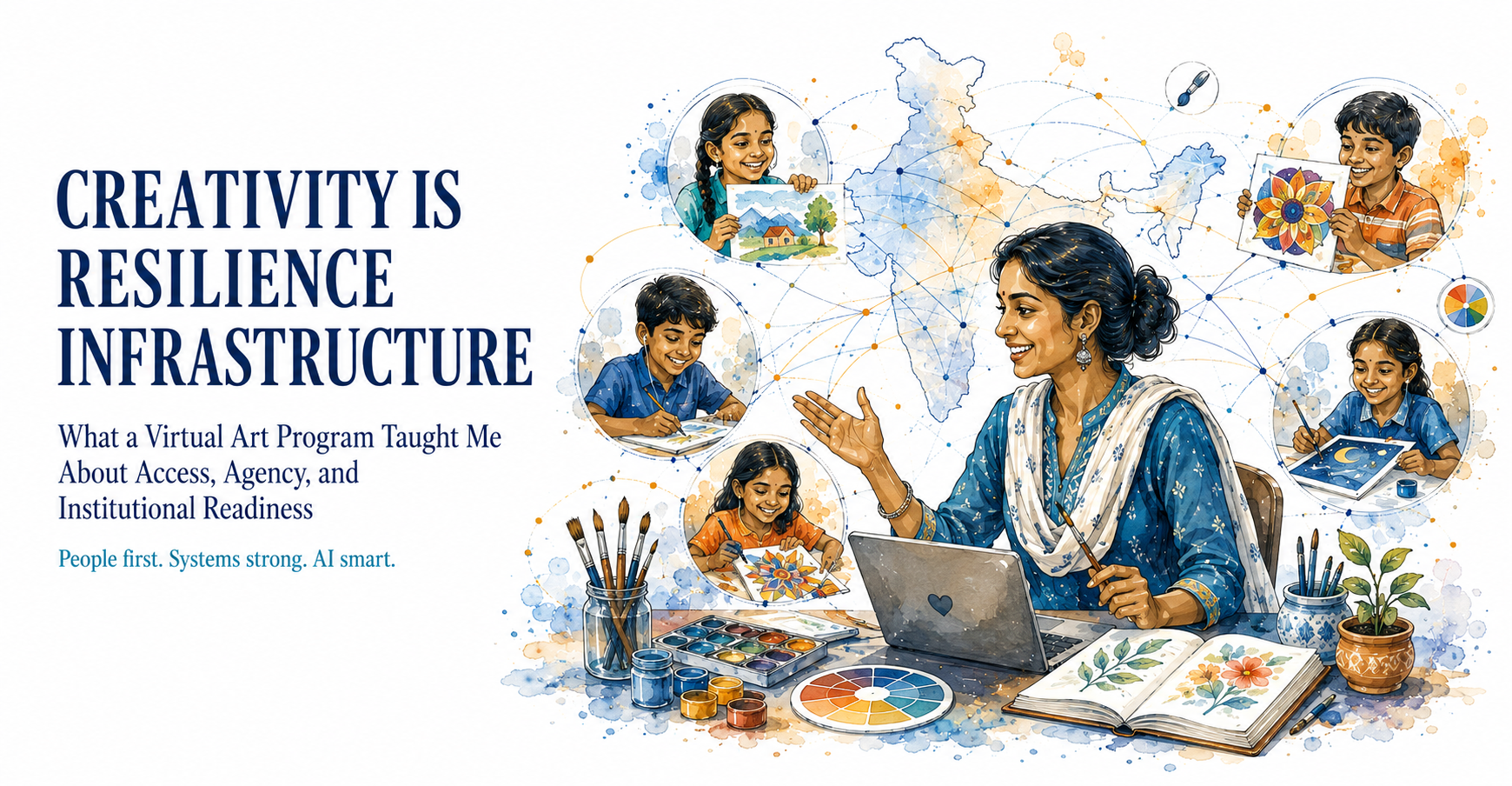
Creativity Is Resilience Infrastructure
It all begins with an idea.
What a virtual art program for more than 50 underprivileged children in India taught me about access, agency, and institutional readiness
Creative education is not an extra at the edge of the system. It strengthens agency within the system.
Introduction
During the height of the COVID-19 pandemic, education systems learned a difficult lesson: access to a platform is not the same as access to learning. In India, school closures affected approximately 286 million students. A UNICEF India rapid assessment found that only 60% of surveyed students had used any remote-learning resource; among those who did, nearly 80% reported learning less or significantly less than at school. The disruption was academic, social, and emotional. The same assessment reported that many children had weak contact with teachers and that poor mental and socio-emotional health was a significant barrier. Technology enabled continuity for some, but it also exposed the limits of systems designed around devices rather than human circumstances.
At the same time, the strategic value of creativity was becoming harder to dismiss. UNESCO’s 2025 implementation guidance for its Framework for Culture and Arts Education positions culture and the arts as integral to inclusive, equitable, quality education and links them with creativity, critical thinking, and respect for cultural diversity. The OECD’s PISA analysis of creative thinking found that curiosity, persistence, perspective-taking, openness to art and experience, and creative self-efficacy were positively associated with stronger creative-thinking performance. For employers, the World Economic Forum’s Future of Jobs Report 2025 ranks creative thinking among today’s core skills and expects it to grow in importance through 2030.
It was within this tension—digital possibility versus unequal access, educational continuity versus emotional isolation—that I designed and led a virtual art program for more than 50 underprivileged children across India. The curriculum covered drawing, painting, color theory, composition, and mixed media using materials available at home. Individual mentoring helped children identify strengths, express difficult emotions, communicate digitally, and build confidence. The strategic thesis that emerged is broader than art education: resilient institutions design for agency under constraint. They combine accessible tools, human mentorship, ethical safeguards, multiple delivery pathways, and disciplined learning loops so that participation produces capability rather than merely attendance.
Eight Strategic Leadership Principles
1. Agency comes before access
Give people a means to act, not merely a channel to receive. The children in the program did not need another stream of content. They needed permission, structure, and encouragement to create something that was unmistakably their own. A household pencil, scrap of cardboard, or limited set of colors became useful because the lesson treated the child as a maker rather than a passive viewer. This distinction applies directly to organizations. Digital transformation often measures logins, licenses, and course completion while overlooking whether people can exercise judgment, produce original work, and influence outcomes. The OECD’s PISA findings show that students who viewed creativity as applicable across subjects performed better in creative thinking, even after accounting for socioeconomic factors. Boards should therefore ask a harder question than, ‘Who has access?’ They should ask, ‘What can people now do that they could not do before?’ Programs should be evaluated through evidence of choice, experimentation, self-efficacy, and contribution. Access is an input. Agency is the institutional outcome that makes access worth funding.
2. Equity must be designed at the edge
Inclusion is not achieved by opening the same door for everyone. It is achieved by understanding why some people cannot reach the door. The virtual art curriculum was adapted to ordinary household materials because requiring specialized supplies would have converted an educational opportunity into a test of family income. The digital format also had to respect device sharing, inconsistent connectivity, limited space, and different levels of adult support. UNICEF India’s assessment found that 10% of surveyed students lacked access to a smartphone, feature phone, television, radio, or computer, while girls, younger learners, rural students, and government-school students used high-tech tools less often. These disparities are governance signals, not implementation inconveniences. Boards should require equity impact assessments before approving digital learning, workforce, or community programs. That means segmenting access data, examining hidden costs, providing low-bandwidth and asynchronous options, using local languages, and preserving non-digital routes where necessary. Ethical inclusion begins at the system’s edge, where standardized assumptions encounter real lives.
3. Readiness is built through constraint-aware design
Resilient systems are designed to function under imperfect conditions. During the pandemic, the art program could not depend on studios, uniform supplies, uninterrupted broadband, or parents with teaching experience. The curriculum therefore used modular lessons, repeatable demonstrations, locally available materials, and assignments that could be completed independently. This was not a compromise on quality; it was a redesign of quality around context. The World Bank’s 2022 learning-poverty update warned that pandemic disruption compounded an already severe global learning crisis, reinforcing the need to recover learning and build systems better able to withstand future shocks. Executive teams should apply the same logic to organizational readiness. A program is not ready because it works in a controlled pilot. It is ready when roles are clear, essential content is lightweight, facilitators can adapt, failure modes are anticipated, and participants can continue when the preferred channel breaks. Constraint-aware design converts fragility into operational choice. Boards should demand evidence that transformation initiatives have been tested against the conditions most likely to exclude, delay, or discourage participation.
4. Capability grows through practice and feedback
Confidence follows evidence of progress. Each lesson balanced a technical element—line, color, composition, texture—with space for children to interpret the task in their own way. Individual feedback helped them see improvement without turning creative work into a compliance exercise. This combination of structure and autonomy matters in every capability-building system. The National Endowment for the Arts’ 2025 evidence review found positive correlations between out-of-school arts participation and several social-emotional and academic outcomes, including positive approaches to learning, interpersonal skills, and engagement; it also cautions that some relationships vary after demographic and family factors are considered. The careful conclusion is not that art automatically produces performance. It is that repeated, supported participation may strengthen the behaviors on which learning depends. Boards should challenge one-off training models that confuse exposure with competence. Effective capability programs create cycles of demonstration, practice, individualized feedback, reflection, and increasingly complex application. Skills become adaptable when learners understand both the technique and the reasoning behind it.
5. Safeguarding is part of creative freedom
Human-centered programs require boundaries strong enough to make expression safe. Children were encouraged to tell stories through art, but that freedom carried responsibilities: age-appropriate instruction, respectful feedback, privacy, predictable interactions, and sensitivity to emotional distress during isolation. In digital settings, safeguarding must also address consent, image sharing, platform access, adult supervision, and the risk that a child’s work or personal experience is exposed beyond the intended learning space. The WHO review of arts and health evidence synthesizes more than 3,000 studies and identifies roles for the arts in health promotion and the management of health conditions, while the breadth of study designs also calls for careful interpretation rather than exaggerated promises. Leaders should treat emotional benefit as a possible outcome, not a license to operate without professional limits. Boards overseeing youth, employee, or community programs should require clear safeguarding ownership, facilitator training, escalation protocols, data minimization, and accessible reporting channels. Ethical design does not constrain meaningful participation; it creates the trust that allows participation to deepen.
6. Communication keeps distributed communities coherent
Remote participation becomes community only when communication is intentionally designed. In the art program, instructions had to be clear enough for independent action, flexible enough for varied home environments, and warm enough to reduce the emotional distance of a screen. Feedback loops also mattered: children needed to show work, ask questions, hear encouragement, and learn from peers. Silence in a distributed system is ambiguous—it may signal understanding, hesitation, exclusion, or disconnection. UNICEF India found that 30–40% of surveyed students were not in contact with teachers during closures, with younger and rural learners less likely to be connected. The lesson for institutions is that communication cannot be reduced to message transmission. Boards should assess whether people can respond, whether non-response triggers responsible follow-up, and whether communication channels fit the audience’s language, bandwidth, safety, and confidence. Stable cultures are built through predictable cadence, visible listening, and closed feedback loops. In remote programs, responsiveness is not courtesy. It is part of the operating control that prevents participants from quietly disappearing.
7. Redundancy turns fragile delivery into resilience
A single elegant channel can be less resilient than several imperfect ones. The art program worked because learning was grounded in activities children could continue away from the screen. That principle scales. India’s education response combined digital portals, television, radio, community radio, podcasts, and printed materials because no single delivery method could reach every learner. Redundancy is often criticized as inefficiency, yet in crisis it becomes continuity. It also gives institutions options when bandwidth, staffing, devices, or local conditions change. Boards should distinguish wasteful duplication from purposeful resilience. Critical learning and community programs need minimum-service definitions, alternative channels, local facilitators, reusable content, and offline continuity plans. Leaders should test which functions survive a connectivity failure, a platform outage, a facilitator absence, or a sudden increase in demand. The objective is not to replicate the full experience everywhere. It is to preserve the essential outcome—continued learning, human contact, and a credible path back into the program. Resilience is the capacity to continue meaningfully, not merely remain technically available.
8. Creative confidence compounds into strategic value
The final value of creative education is not a collection of finished drawings. It is a strengthened belief that uncertainty can be approached, interpreted, and shaped. The World Economic Forum reports that creative thinking, resilience, flexibility, agility, curiosity, and lifelong learning are among the human capabilities expected to rise in importance as technology reshapes work. These capabilities are mutually reinforcing. A person who has practiced generating alternatives, tolerating imperfection, receiving feedback, and revising an idea is better prepared for unfamiliar problems. Organizations should therefore stop treating creative development as unrelated to strategy. Boards can connect arts, design, and maker-based learning with workforce adaptability, leadership development, innovation, and social impact—without reducing art to a productivity tool. The strategic advantage comes from a culture in which more people believe they can contribute original judgment. Such confidence is difficult to purchase at the moment of crisis. It must be cultivated through repeated experiences of responsible experimentation, visible progress, and recognition. Inclusive creativity becomes long-term value when institutions protect it, measure it carefully, and give it room to mature.
Three Real-World Applications
Application 1: Virtual Art Education in India — Design dignity into delivery
The program described here reached more than 50 underprivileged children across India during the pandemic. Its leadership challenge was not simply to move art instruction online; it was to make structured creative learning possible despite uneven connectivity, limited materials, isolation, and varied confidence. The response combined an accessible curriculum, household supplies, technical skill-building, open-ended expression, and individual mentoring. According to the author’s program experience, participants strengthened artistic skills while also developing digital literacy, communication, and self-esteem. These are practitioner-observed outcomes, not the results of an independent evaluation, and should be presented with that distinction intact. The broader context documented in UNICEF India’s rapid assessment of learning during school closures shows why the design mattered: device access, teacher contact, awareness, gender, and location all shaped remote-learning participation. The case brings Principles 1 through 6 together. Its lesson for leaders is to begin with lived constraints, preserve human feedback, and define success as increased agency rather than digital reach alone.
Application 2: India’s PM e-VIDYA — Build multimodal public infrastructure
India’s PM e-VIDYA initiative illustrates the institutional value of multiple delivery pathways. The government platform unifies digital, online, and on-air education, linking the DIKSHA content infrastructure with television channels, radio, community radio, podcasts, and specialized content for children with disabilities. Its strategic importance lies less in any single technology than in the recognition that educational access is heterogeneous. A smartphone application may work for one household; television, radio, print, or a community channel may be more reliable for another. This is Principles 2, 3, 6, and 7 at national scale: equity at the edge, constraint-aware readiness, coherent communication, and purposeful redundancy. The governance challenge is to maintain quality, accessibility, localization, and feedback across a distributed ecosystem rather than assuming that broadcast equals learning. Contemporary institutions can apply the same lesson by designing portfolios of access, establishing common standards across channels, and collecting disaggregated evidence about who participates, who persists, and who remains unseen.
Application 3: UNICEF and Microsoft’s Learning Passport — Scale without abandoning context
The Learning Passport offers a global example of public-purpose technology designed for disrupted education. UNICEF reports that the platform had reached more than 10 million registered users across 47 countries by March 2025. The program is powered by Microsoft Community Training and supports online, mobile, and offline delivery, localized content, and portable learning records. A Microsoft account of the partnership documents the company’s role and the platform’s offline hub model; those corporate claims should be read as evidence of design and deployment, not as independent proof of educational impact. The case connects Principles 2, 3, 6, 7, and 8. Its broader lesson is that scale should distribute adaptability, not enforce sameness. Boards governing similar partnerships should define public accountability, local content authority, privacy protections, offline continuity, and outcome measurement before expansion. Technology becomes resilience infrastructure when it carries context rather than erasing it.
Conclusion
The virtual art program began as a response to an immediate human need: children were isolated, learning systems were disrupted, and structured creative opportunity was scarce. Yet its deeper lesson is institutional. When leaders design around real constraints, modest resources can support meaningful agency. A pencil can become a learning tool; a screen can become a community space; a lesson can become a feedback loop through which a child discovers competence and voice.
For boards, policymakers, and executive teams, the next decade will reward organizations that can combine digital reach with human judgment. That requires equity designed at the edge, readiness tested under imperfect conditions, capability built through practice, safeguarding embedded in delivery, communication that notices absence, and redundant channels that preserve essential outcomes. It also requires disciplined evidence: distinguishing observed experience from independent evaluation, measuring who is excluded as carefully as who participates, and resisting claims that technology or creativity alone will solve structural disadvantage.
If institutions treat creative education as optional, they risk weakening the very capabilities they will need in periods of disruption—curiosity, confidence, interpretation, empathy, and the ability to generate alternatives. If they treat it as resilience infrastructure, they can widen participation while strengthening the human capacity to adapt responsibly. The leadership imperative is simple: design access for reality, protect agency through governance, and convert imagination into durable capability.
People first. Systems strong. AI smart.During the height of the COVID-19 pandemic, I designed and led a virtual art education program for more than 50 underprivileged children across India, transforming limited digital access into a platform for creativity, confidence, and connection.
Recognizing the lack of structured arts education in underserved communities, I developed a comprehensive curriculum that introduced students to drawing, painting, color theory, composition, and mixed-media techniques, adapted to materials they could easily find at home. Each lesson balanced technical skill-building with creative expression, encouraging students to tell their own stories through art.
Beyond teaching, I also mentored children individually, helping them discover their strengths and use art as a form of emotional resilience during isolation. The program not only improved artistic skills but also enhanced digital literacy, communication, and self-esteem, creating a lasting impact that continued even after the pandemic.
This experience deepened my commitment to inclusive education and creative empowerment, proving that art can transcend barriers of geography, technology, and circumstance — and that meaningful change often begins with imagination.
