
Introducing AEGIS™: A Governance Framework for the AI Era
Introduction
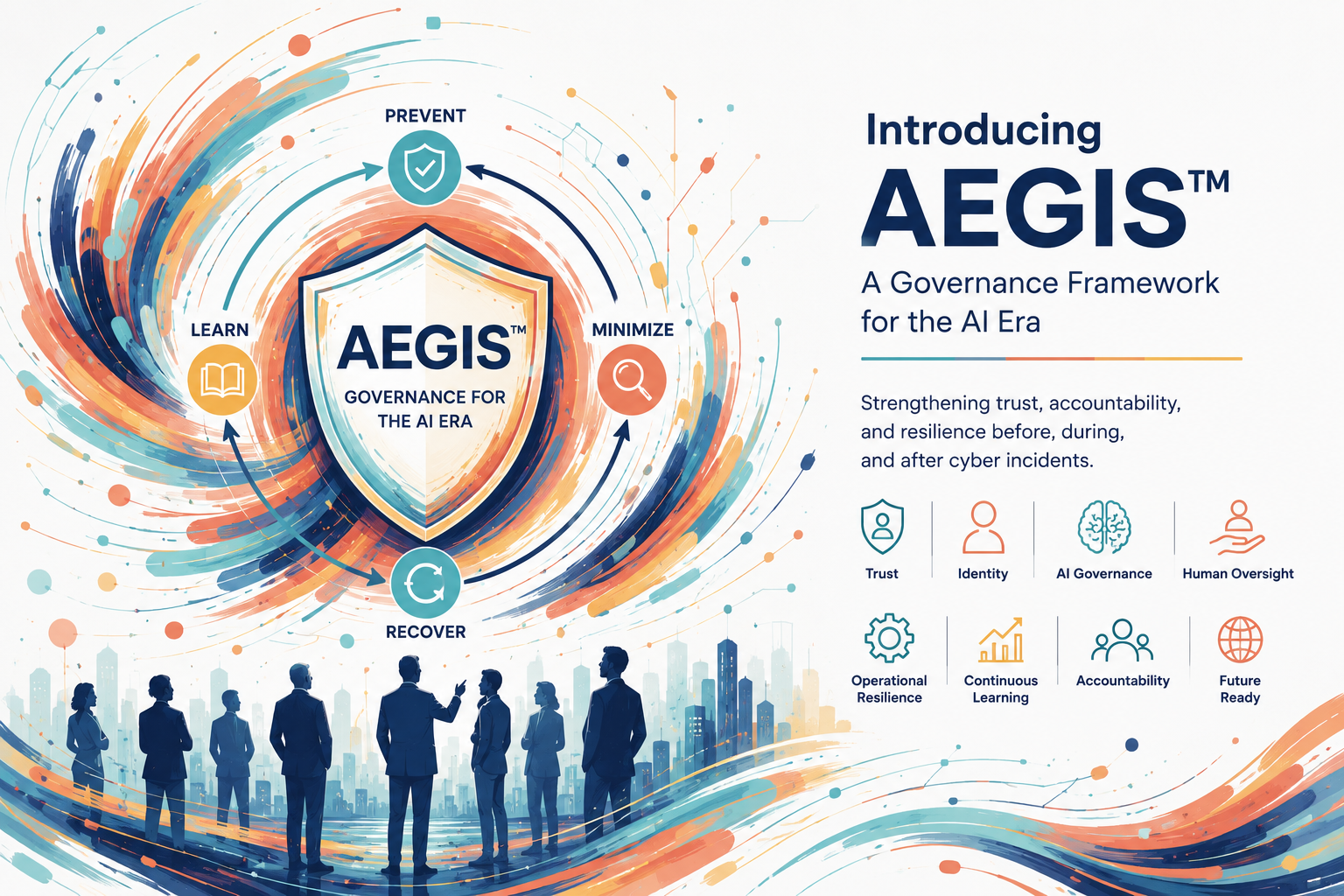
Artificial intelligence is transforming how organizations operate, make decisions, and manage risk. While existing cybersecurity and governance frameworks provide valuable guidance for protecting technology, the rapid growth of autonomous AI systems requires organizations to also govern trust, accountability, human oversight, and organizational resilience. AEGIS™ was developed to help organizations strengthen governance before, during, and after cyber incidents by integrating these principles into a continuous lifecycle of improvement.
1. Governing Trust
Trust should never be assumed—it should be continuously earned and verified. As organizations increasingly rely on AI systems, cloud platforms, third-party services, and interconnected ecosystems, governance must ensure that trust is established through continuous verification rather than implicit assumptions.
2. Governing Identity
Every human, machine, application, and AI agent represents an identity that requires governance. Strong identity governance, least-privilege access, and continuous authentication help reduce unnecessary risk while protecting critical organizational assets.
3. Governing Autonomous AI
AI systems are becoming increasingly capable of making recommendations and executing decisions with minimal human intervention. Governance should define the boundaries, responsibilities, permissions, and accountability required to ensure autonomous systems operate safely, ethically, and in alignment with organizational objectives.
4. Governing Human Oversight
As automation increases, human judgment becomes even more important. Governance should define where human review, executive oversight, and board accountability remain essential, particularly for high-impact decisions involving security, privacy, compliance, and organizational risk.
5. Governing Operational Resilience
Cybersecurity is no longer measured solely by an organization's ability to prevent attacks. Resilience is demonstrated by the ability to detect, respond, recover, and continue operating while minimizing disruption to customers, stakeholders, and business operations.
6. Governing Continuous Learning
Every cyber incident, operational failure, or governance challenge provides an opportunity to improve. Organizations should continuously evaluate lessons learned, strengthen governance processes, and adapt their operating models as technologies, threats, and business environments evolve.
7. Governing Accountability
Effective governance requires clearly defined ownership for decisions, risks, and outcomes. Accountability should exist across leadership, technology teams, business functions, and AI-enabled processes to ensure that governance responsibilities remain transparent and measurable.
8. Governing the Future
The pace of technological change will continue to accelerate. Governance frameworks must therefore remain adaptive, enabling organizations to continuously evaluate emerging technologies, evolving risks, regulatory expectations, and changing stakeholder needs while maintaining trust and resilience.
These principles form the foundation of the AEGIS™ lifecycle: Prevent, Minimize, Recover, and Learn. Rather than replacing existing cybersecurity or governance frameworks, AEGIS™ complements them by providing an executive governance perspective that strengthens organizational resilience throughout the entire incident lifecycle.
Real-World Examples
Hugging Face (2026)
The Hugging Face security incident demonstrated how autonomous AI capabilities, untrusted data processing, and cloud infrastructure can introduce new governance challenges. The incident reinforced the importance of governing trust, identity, workload isolation, and human oversight as organizations increasingly integrate AI into enterprise operations. (Hugging Face, "Security Incident Disclosure – July 2026")
SolarWinds (2020)
The SolarWinds Orion supply chain attack illustrated how implicit trust in software updates can create enterprise-wide risk. The incident highlighted the importance of continuous verification, software supply chain governance, and validating trusted relationships rather than assuming they remain secure. (U.S. Securities and Exchange Commission, "SEC Charges SolarWinds and Chief Information Security Officer with Fraud, Internal Control Failures")
Capital One (2019)
The Capital One cloud breach demonstrated how governance failures surrounding cloud configurations, identity management, and access controls can expose sensitive information even within highly sophisticated technology environments. The incident reinforced that cybersecurity resilience depends on strong governance as much as technological capability. (U.S. Department of Justice, "Former Seattle Tech Worker Convicted of Wire Fraud and Computer Intrusions")
Conclusion
The AI era requires organizations to think beyond traditional cybersecurity and embrace governance as a strategic capability. AEGIS™ was developed to help organizations strengthen trust, accountability, resilience, and continuous learning as intelligent systems become increasingly integrated into enterprise operations. By focusing on governance before, during, and after cyber incidents, AEGIS™ provides leaders with a practical framework for navigating complexity while supporting responsible innovation.
This article introduces the foundation of AEGIS™. Future articles will apply the framework to real-world cybersecurity incidents to explore how governance decisions influence organizational resilience, executive accountability, and long-term business value in an increasingly AI-driven world.
Continue Reading: To see AEGIS™ applied in practice, explore my governance analysis of the Hugging Face security incident published in Influential Women, where I examine the incident through the AEGIS™ framework and highlight key governance lessons for organizations navigating the AI era.
Read the article: Governance Lessons from the Hugging Face Incident (Influential Women)